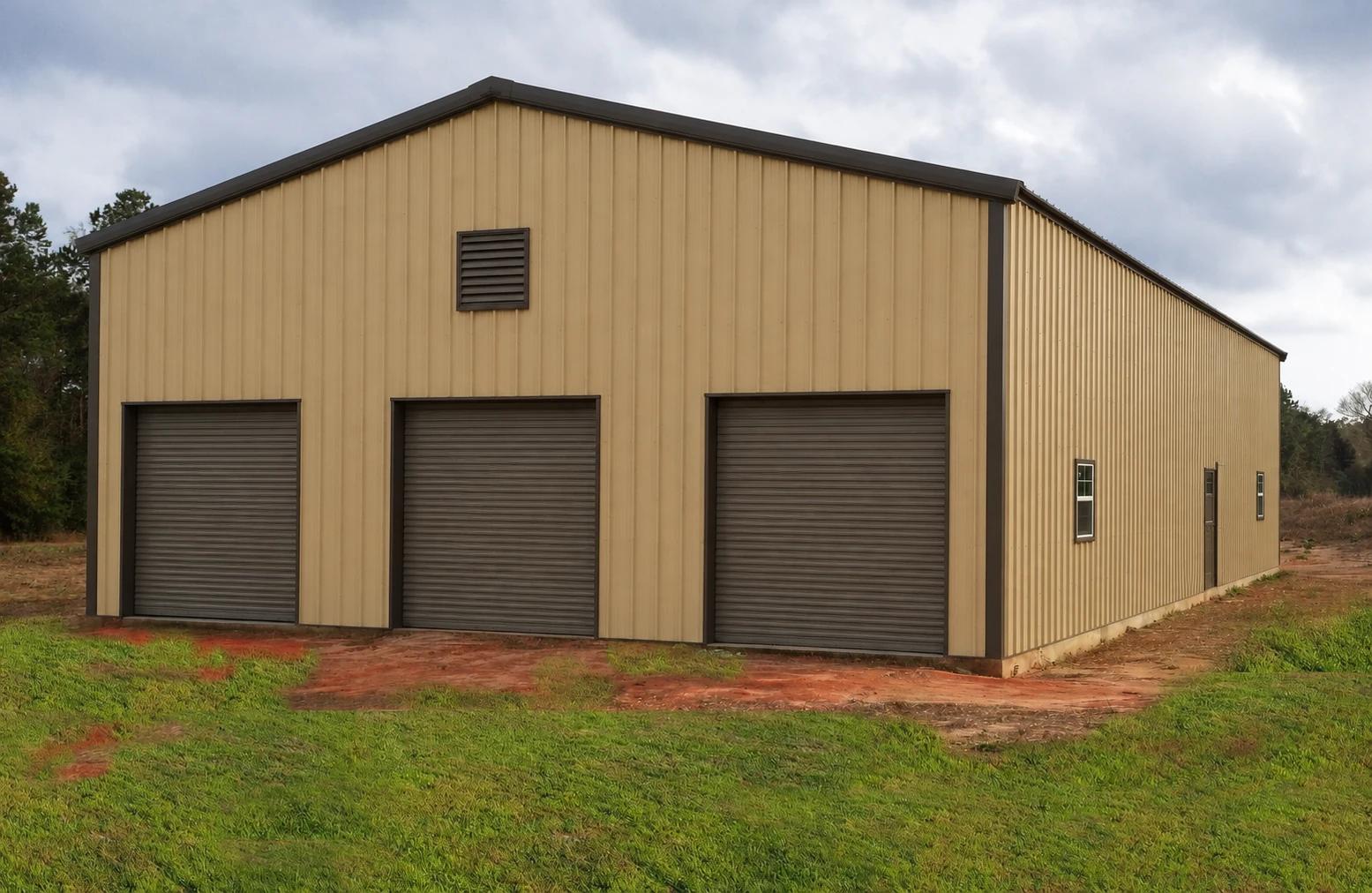
50x50 by eave height
Starting prices, delivered to your site with engineered drawings sealed in your state. Each height has its own page with what fits and the door it takes.
| Building | Starts at | Overhead door | Good for |
|---|---|---|---|
| 50x50x12 | $38,675 | up to about 10 ft | Cars, pickups and a working shop |
| 50x50x14 | $40,725 | up to about 12 ft | Equipment, service trucks and a car lift |
| 50x50x16 | $43,125 | up to about 14 ft | RVs, semis and storage up high |
| 50x50x18 | $45,550 | up to about 16 ft | Combines, semis with room overhead, racking three high |
| 50x50x20 | $47,950 | up to about 18 ft | Crane bays, tall racking and the biggest equipment |
Any other eave height is built to order and priced on your quote. Door height is confirmed on your drawings.
What moves the price from here
A square building carries more wall for each square foot of floor than a rectangular one, and wall is where the panel, the trim and every opening go. Fifty feet of clear span on both axes is also more frame than a narrower building of the same area needs. Both of those push this size up the per-square-foot column rather than down it.
The biggest movers, in order: design loads set by your county, eave height, and how many openings you cut into the walls. Freight is already inside the number rather than added to it.
What actually fits in 2,500 sq ft
- Turning inside the building — The honest reason to buy square. A trailer, a truck and trailer, or a piece of equipment can come in, turn, and go back out without reversing the length of the building.
- Work that happens around something — A single large item with access on all four sides — restoration, fabrication, repair — rather than a line you move along.
- Equipment that is wide as well as long — Where the width is the constraint and the extra length of a rectangle would be wasted.
- A building on a square site — Setbacks and parcel shape often make square the natural fit.
Eave height, sized to what goes inside
Fifty feet of width invites people to go up, and at this footprint that is usually the right instinct — a lift, racking, a hoist. Tell us what is going up and we design the frame around the answer — the difference between the height that works and the height that nearly works is small.
Tell us what is going inside and we size the eave height around it. If you are between two numbers, we will go over whether the difference matters when we quote.
When 50 × 50 is the wrong answer
If you are buying square because it sounds efficient, it is not. A 40 × 60 is a hundred square feet smaller and starts lower, and for most shop work sixty feet of length is more useful than ten extra feet of width. Buy the square only if turning inside the building is a real requirement — that is the one thing the shape does that a rectangle cannot.
What the next sizes cost
Cost per square foot generally falls as the building gets bigger, so the next sizes up are worth a look.
| Size | Square feet | Starting price | Per sq ft |
|---|---|---|---|
| 50 × 50 | 2,500 | $43,125 | $17.25 |
| 40 × 60 | 2,400 | $40,920 | $17.05 |
| 50 × 60 | 3,000 | $51,600 | $17.20 |
| 60 × 60 | 3,600 | $58,860 | $16.35 |
Look at 40 × 60 first. It is the same order of money for a different shape, and the question this page really asks is whether you need to turn around inside or work down a line.